.avif)
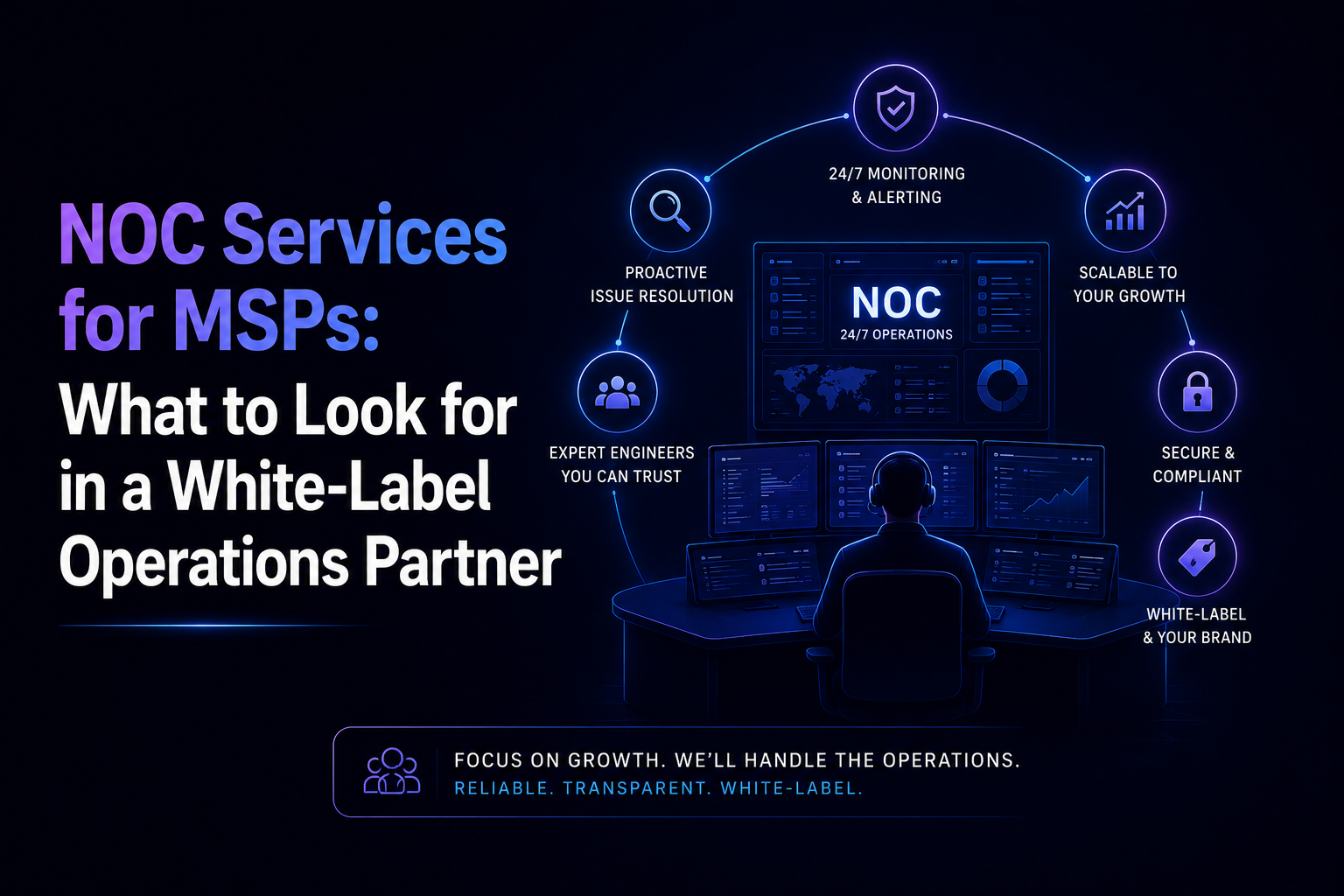

Your clients do not stop generating alerts at 5 pm. Infrastructure does not wait for business hours to develop problems. But staffing a genuine 24/7 operations capability internally is expensive, operationally complex, and increasingly difficult in a market where qualified technicians are hard to retain. This is the problem that NOC services for MSPs are designed to solve, and it is why more MSPs are evaluating outsourced NOC partnerships as a structural capacity decision rather than a last resort.
NOC services for MSPs provide 24/7 infrastructure monitoring, alert triage, incident response, and escalation management, delivered under the MSP's brand so the end client never sees the third-party provider. The right white-label NOC partner extends your operational capacity without adding headcount, allows your internal team to focus on higher-value work, and delivers consistent response quality across your client portfolio regardless of the time of day. The wrong one gives you a monitoring dashboard with a phone number and calls it a NOC.
This guide covers what a genuine managed NOC provider actually delivers, the specific criteria that separate high-quality white-label NOC services from commodity alert forwarding, the questions to ask before signing a contract, and what to look for in an outsourced NOC MSP partnership that will hold up under the operational demands of real client environments. It is written for MSP owners who are evaluating NOC partnerships seriously, not for those looking for a quick vendor comparison.
QUICK ANSWER: What Are NOC Services for MSPs?
NOC services for MSPs are outsourced, white-label network operations centre functions, covering 24/7 monitoring, alert triage, incident response, and escalation management, delivered under the MSP's own brand. A genuine managed NOC provider acts as an extension of the MSP's delivery team, resolving incidents within defined parameters and escalating only what requires the MSP's direct involvement. This allows MSPs to offer 24/7 operational coverage without the cost and complexity of building and staffing an internal NOC.
Why the NOC Decision Is One of the Most Consequential Choices an MSP Makes
The NOC function sits at the centre of managed service delivery. It is where the operational promise of 24/7 managed services either holds or breaks. Every alert that goes unacknowledged outside business hours, every incident that escalates to a client before the MSP's team is aware of it, and every SLA breach that occurs during a weekend or holiday is a direct product of the NOC layer, or its absence.
The business case for outsourced NOC services for MSPs has strengthened considerably as the market has matured. According to Datto's State of the MSP Industry report, the average MSP now supports clients across multiple time zones and industries with varying uptime requirements. At the same time, the cost of employing experienced NOC technicians has risen significantly: base salaries for NOC analysts in the US range from $45,000 to $75,000 annually, and building genuine 24/7 in-house coverage requires a minimum of four to six full-time staff to maintain rotation without burnout. For most MSPs under $5M ARR, this is neither financially viable nor operationally practical.
The alternative, white-label NOC services, allows MSPs to present 24/7 operational coverage to clients as part of their core service offering, with the NOC function delivered by a specialist provider under the MSP's brand. When this partnership is well-structured, the end client experiences seamless, continuous coverage. When it is poorly structured, the MSP discovers the difference between a genuine managed NOC provider and a monitoring platform with a human overlay only when something serious goes wrong with a client's environment.
What to Look for in a White-Label NOC Provider: 7 Criteria That Actually Matter
Not all NOC services for MSPs are built the same. The following criteria are what distinguish a genuine white-label operations partner from a commodity monitoring service dressed up with NOC branding. Evaluate any provider you are considering against each one before committing to a contract.
01 — True White-Label Delivery: Your Brand, Consistently
White-label NOC services mean the end client never encounters the third-party provider's name, branding, or contact information. Every communication, ticket update, client-facing notification, and escalation call should carry the MSP's branding. This is not a cosmetic detail. For MSPs whose competitive positioning rests on being the single point of contact for their clients, a NOC partner that surfaces its own identity in client interactions undermines that positioning directly.
Ask specifically: how is client communication handled during an incident? What name appears on outbound calls? What does the ticket header show? How are email notifications branded? Request samples of actual client-facing communication from the provider's current operations. A provider that cannot produce clean white-label examples across all communication channels is not genuinely white-label, regardless of what the sales materials say.
The most rigorous white-label NOC providers go further than branding. They train their technicians to answer calls using the MSP's company name, refer to themselves as part of the MSP's team in client interactions, and follow the MSP's communication protocols rather than their own. This level of integration is what a genuine operations extension looks like in practice.
02 — Defined Resolution Capability, Not Just Alert Forwarding
The distinction that separates a genuine managed NOC provider from a glorified monitoring dashboard is resolution capability. Alert forwarding means the NOC receives an alert, logs a ticket, and contacts the MSP. Resolution means the NOC technician works the incident within a predefined scope of authority, applying documented remediation steps before escalating only what genuinely requires the MSP's involvement.
Ask any prospective NOC partner for their first-contact resolution rate and their mean time to resolution for common alert categories. A genuine NOC should be resolving a meaningful percentage of standard incidents, including server restarts, connectivity drops, patch failures, and backup alerts, without escalating to the MSP. If the answer is that all incidents are escalated, what you are evaluating is a monitoring platform, not a NOC.
Resolution capability requires two things: documented runbooks for common incident types that the NOC team actively maintains and follows, and a defined scope of authority that specifies what the NOC can remediate independently versus what requires MSP approval. Both should be contractually documented. An outsourced NOC MSP partner that cannot show you their runbook library and scope definition is operating without the infrastructure that makes genuine resolution possible.
03 — Integration With Your PSA and RMM, Not a Parallel System
A white-label NOC that operates outside your PSA and RMM creates two problems simultaneously. First, all NOC activity becomes invisible in the operational record your team uses to manage client environments, which means your technicians are working without context when they pick up an escalation. Second, billing, SLA tracking, and time accounting for NOC activity cannot be captured in your existing reporting infrastructure, which creates both financial and contractual risk.
Genuine NOC services for MSPs integrate directly into the MSP's existing toolstack. Tickets are created, updated, and closed within the MSP's PSA. Alert sources are pulled from the MSP's RMM. Escalation paths are configured within the existing workflow. The NOC operates as a functional extension of the MSP's delivery infrastructure, not as a separate system that runs in parallel.
Ask specifically which PSA and RMM platforms the provider integrates with natively, and ask to see the integration documentation. Native integration is meaningfully different from a manual data transfer or a webhook that creates duplicate records. If the provider cannot integrate with your specific toolstack, the operational overhead of managing the relationship will partially offset the capacity it was intended to create.
04 — Documented Escalation Protocols With Defined Response Windows
The escalation path is where NOC partnerships most commonly fail to deliver on their operational promise. When an incident exceeds the NOC's scope of authority and requires MSP involvement, how that escalation happens, how quickly, through which channel, with what information, and to whom, determines whether the partnership functions as a genuine capacity extension or creates a new layer of operational friction.
A well-structured outsourced NOC MSP partnership has escalation protocols that are documented, tested, and specific. They define the maximum time between alert receipt and first response, the maximum time before escalation if the NOC cannot resolve, the specific channel through which escalation occurs for different severity levels, and the information that accompanies every escalation so the receiving technician has full context without needing to review the RMM independently.
Escalation protocols should also define out-of-hours contact paths for critical incidents. If a P1 incident occurs at 2 am and the on-call technician is not reachable within the defined window, what is the next step? Who is the secondary contact? What is the escalation path for an MSP that does not have a formal on-call rotation? These are not edge cases. They are the scenarios in which the quality of the NOC partnership is most directly tested.
05 — Client Environment Documentation and Knowledge Transfer
A NOC that does not hold accurate, current documentation on each client environment it monitors is operating on assumptions. When an alert fires on a server the NOC has no context on, the technician's first step is not resolution. It is investigation to establish what normal looks like for that environment. That investigation takes time, and in a genuine incident, time is the variable that determines client impact.
Ask prospective white-label NOC providers how client environment documentation is managed. Is it held within the provider's own system, within the MSP's documentation platform, or both? Who is responsible for keeping it current when client environments change? What is the process when the NOC encounters an undocumented device or configuration? The answers to these questions reveal whether the provider has built documentation infrastructure into their operations or treats it as an afterthought.
The strongest managed NOC providers have a defined onboarding process for each new client environment that results in documented baselines for all monitored infrastructure. They also have a feedback mechanism that updates documentation when they encounter configuration drift or undocumented changes during incident response. This documentation infrastructure is one of the most significant quality differentiators between NOC providers, and it is rarely discussed in sales conversations.
06 — Transparent Performance Reporting You Can Share With Clients
The NOC function generates operational data that is directly relevant to the MSP's client reporting and QBR conversations: alert volumes by category, mean time to acknowledgement, mean time to resolution, escalation rates, and incident trends over time. A white-label NOC partner that does not provide this data in a format the MSP can use is leaving a significant client retention tool on the table.
Ask prospective providers what reporting is available, at what frequency, and in what format. Can the data be exported for inclusion in the MSP's own client reports? Can it be white-labelled with the MSP's branding? Is there a client-facing dashboard option, or does all reporting flow through the MSP? The more granular and accessible the reporting, the more operational value the NOC delivers beyond the primary function of incident response.
Performance reporting also serves an internal function. Without visibility into NOC performance metrics, the MSP cannot assess whether the partnership is delivering the service levels it was contracted to provide, identify patterns in alert volume that signal underlying client infrastructure issues, or make evidence-based decisions about when to adjust the NOC's scope of authority for specific client environments.
07 — Commercial Structure That Aligns With How MSPs Grow
The commercial model of a white-label NOC partnership should align with the MSP's own commercial model, not create misaligned incentives. Per-device pricing models are the most common and the most compatible with MSP billing structures, because the NOC cost scales predictably with the client base. Per-alert or per-ticket pricing creates cost unpredictability that makes it difficult to include NOC coverage in fixed-price managed service agreements.
Ask specifically: what is included in the base per-device fee, and what triggers additional charges? Common sources of unexpected cost include out-of-scope remediation activities, excessive escalation volumes attributed to the MSP's alert configuration rather than genuine incidents, and onboarding fees for new client environments that were not clearly disclosed upfront. Read the contract carefully for any clause that ties cost to activity volume rather than to the managed device count.
The strongest managed NOC providers offer contractual flexibility that reflects the MSP's growth trajectory: monthly rolling terms for early-stage engagements, volume pricing that improves as the device count grows, and no penalties for client churn that reduces the device base. MSP-aaS structures its NOC partnership model specifically around how MSPs grow, with pricing and terms designed for the operational reality of a scaling managed service business.
Real NOC vs. Monitoring Dashboard: The Difference at a Glance
Before evaluating specific providers, it is worth being clear on what separates a genuine managed NOC from a monitoring platform with human alert forwarding.
5 Mistakes MSPs Make When Choosing a NOC Partner
Mistake 1: Selecting a provider based on price without evaluating resolution capability The cheapest NOC services for MSPs are almost always alert forwarding services. The cost saving relative to a genuine managed NOC provider is real. So is the difference in operational value. A NOC that forwards every alert to the MSP's on-call technician does not extend capacity. It creates a more expensive version of the same after-hours problem the MSP was trying to solve. Evaluate resolution rate and runbook depth before evaluating price.
Mistake 2: Not testing white-label delivery before the contract is live White-label integration failures almost always surface during an actual client incident, which is the worst possible time to discover them. Before signing a contract, test the provider's white-label delivery end to end: generate a test alert, follow the ticket through the workflow, and verify that every client-facing touchpoint carries only the MSP's branding. Providers that cannot accommodate pre-contract testing are signalling that their integration is not as clean as their sales materials suggest.
Mistake 3: Treating NOC onboarding as a one-time documentation exercise Client environments change continuously. Servers are added, replaced, and reconfigured. A NOC that was accurately documented at onboarding but not maintained as the environment evolves is progressively less effective at resolving incidents without escalation. Build documentation update requirements into the partnership contract and establish a regular review cadence, not just an onboarding process.
Mistake 4: Not defining escalation protocols before the first live incident Escalation protocol discussions that happen after a critical incident has already been mishandled are conversations that happen too late. Define the escalation path, response windows, communication channels, and information requirements for each severity level before the NOC goes live on a client environment. The escalation protocol is the most operationally consequential document in the NOC partnership, and it is the one most commonly left underdefined.
Mistake 5: Underestimating the importance of PSA and RMM integration depth An outsourced NOC MSP partnership that creates parallel ticket systems or requires manual data transfer adds operational overhead rather than removing it. The integration requirement is not a technical detail to be resolved post-contract. It is a foundational architectural condition that determines whether the partnership functions as a genuine delivery extension or as an additional system the MSP must manage.
What a Well-Structured NOC Partnership Looks Like in Practice
Insert a real MSP-aaS customer story focused specifically on the NOC partnership. Ideal story arc: MSP was struggling to provide credible after-hours coverage, was losing deals to competitors who could demonstrate 24/7 operations, or was experiencing client escalations outside business hours that were damaging relationships.
After deploying MSP-aaS's white-label NOC, include specific outcomes: reduction in after-hours escalations to the MSP's internal team, new client wins attributed to 24/7 coverage capability, improvement in client satisfaction or SLA performance, or ability to move upmarket to clients with genuine 24/7 uptime requirements.
Include: Business name, city, the specific operational gap, the structural change, the measurable result, and a direct owner pull quote.
Questions to Ask Any NOC Provider Before You Sign
These are the specific questions that reveal the operational reality of a NOC provider's service, rather than the version presented in a sales conversation. Use them in every evaluation.
- What is your first-contact resolution rate for the most common alert categories, and can you show me historical data?
- How is white-label delivery handled across all client-facing communication channels? Can I see examples from your current operations?
- Which PSA and RMM platforms do you integrate with natively, and what does the integration architecture look like in practice?
- Walk me through your escalation protocol for a P1 incident at 2 am on a Saturday. What happens if the primary on-call contact is unreachable?
- How is client environment documentation managed, and who is responsible for keeping it current when environments change?
- What performance data do you provide, at what frequency, and in what format? Can it be white-labelled and exported for client reporting?
- What is included in the base per-device fee, and what triggers additional charges outside that fee?
- What are the contract terms? Is there a minimum commitment period, and what happens commercially if I lose a client and the device count decreases?
- How do you handle onboarding a new client environment, and what is the typical timeline from contract to live monitoring?
- Can I speak with two or three current MSP customers about their operational experience with the service?
Tools and Partners That Support MSP NOC Operations
MSP-aaS — Featured — White-label NOC as part of a unified operational platform MSP-aaS delivers NOC services as an integrated component of a broader operational platform that includes Service Desk, SOC, compliance, QBR automation, and reporting, all white-labelled under the MSP's brand. Unlike standalone NOC providers, MSP-aaS is designed as a unified delivery engine so the NOC, Service Desk, and compliance functions share the same operational infrastructure and reporting layer. See how it works at msp-aas.com/demo
RMM Platform (N-able, NinjaRMM, Datto RMM) — Monitoring and alert source The RMM is the alert source that feeds the NOC. The quality of alert configuration, threshold calibration, and alert categorisation within the RMM directly affects NOC performance. Alert hygiene in the RMM should be reviewed before engaging a NOC partner, not after.
PSA Platform (ConnectWise Manage, HaloPSA, Autotask) — Ticket workflow and SLA tracking The PSA is where NOC activity should live operationally. Tickets created, updated, and resolved by the NOC should appear in the MSP's PSA in real time, with accurate SLA timestamps, so the MSP's internal team always has full context on open incidents.
IT Glue / Hudu — Client environment documentation A centralised documentation platform is the repository that makes NOC resolution capability possible. When the NOC team has access to accurate, current client environment documentation, first-contact resolution rates improve significantly.
Gradient MSP / Augmentt — SaaS management and billing reconciliation As client environments increasingly include cloud and SaaS components, the monitoring scope of NOC services must extend beyond on-premise infrastructure. These tools complement traditional NOC monitoring and reduce blind spots in 24/7 coverage.
Frequently Asked Questions
What are NOC services for MSPs?
NOC services for MSPs are outsourced network operations centre functions, including 24/7 infrastructure monitoring, alert triage, incident response, and escalation management, delivered under the MSP's own brand. Rather than building and staffing an internal NOC, the MSP partners with a specialist provider who monitors client environments continuously, resolves incidents within a defined scope of authority, and escalates only what requires the MSP's direct involvement. The end client experiences continuous, branded operational coverage. The MSP extends its delivery capacity without the cost and complexity of internal NOC staffing.
What is the difference between a NOC and a help desk for MSPs?
A NOC and a help desk serve fundamentally different functions in MSP delivery. The NOC is proactive and infrastructure-focused: it monitors client environments continuously, identifies and responds to system-generated alerts, and initiates incident response before clients are typically aware a problem exists. The help desk is reactive and user-focused: it receives inbound requests from end users, handles break-fix issues, and manages service requests. In a mature MSP operating model, both functions exist and are staffed differently. Some MSP-aaS providers, including MSP-aaS, deliver both functions as part of a unified service platform.
How much do outsourced NOC services for MSPs cost?
Outsourced NOC services for MSPs are most commonly priced on a per-device per-month basis, with rates typically ranging from $3 to $10 per monitored device depending on the scope of coverage, the resolution capability included, and the depth of PSA and RMM integration. Entry-level monitoring-only services sit at the lower end of this range. Genuine managed NOC services with documented resolution capability, white-label delivery across all channels, and native PSA integration sit toward the upper end. The relevant comparison is not the per-device rate in isolation but the rate relative to the cost of providing equivalent coverage internally, which for most MSPs is significantly higher on a fully-loaded cost basis.
What does white-label NOC mean?
White-label NOC means the outsourced NOC provider delivers its services entirely under the MSP's brand. End clients see only the MSP's name on tickets, communications, and reports. Outbound calls carry the MSP's company name. Email notifications use the MSP's branding and domain. The third-party provider is operationally invisible to the end client. The quality of white-label integration varies significantly between providers: some offer full multi-channel brand integration, and some offer basic ticket header branding only.
How do I know if my MSP needs an outsourced NOC?
Four situations consistently indicate that an MSP needs outsourced NOC services. First, if after-hours alerts are generating client complaints or SLA breaches because no one is actively monitoring and responding to them. Second, if the internal team is routinely being pulled into after-hours incident response in a way that is creating burnout or retention risk. Third, if the MSP is losing deals to competitors who can credibly demonstrate 24/7 operational coverage. Fourth, if the client portfolio includes businesses with genuine uptime requirements where after-hours infrastructure failures have direct operational consequences. If two or more of these conditions are present, the cost of not having NOC coverage is likely already higher than the cost of procuring it.
Can a small MSP afford white-label NOC services?
The economics of white-label NOC services improve significantly as the monitored device count grows, but they are accessible to MSPs at most revenue levels when evaluated against the alternative. An MSP with 500 monitored devices paying $5 per device per month for NOC coverage is spending $2,500 per month for 24/7 operations capability. The equivalent internal capability, four to six full-time NOC technicians on rotation, costs significantly more on a fully-loaded basis when salary, benefits, management overhead, and attrition cost are factored in. The decision point for most smaller MSPs is not whether NOC services are affordable but whether the current after-hours coverage gap is creating enough client and commercial risk to justify the investment.
What should be included in a white-label NOC contract?
A well-structured white-label NOC contract should specify: the scope of monitoring coverage including which device types and alert categories are included; the resolution scope defining what the NOC can remediate independently versus what requires MSP escalation; escalation protocols including response windows and communication channels for each severity level; white-label delivery requirements covering all client-facing communication channels; PSA and RMM integration specifications; performance reporting requirements; pricing structure including what is included in the base fee and what triggers additional charges; and contract flexibility terms including notice period and provisions for client churn reducing the device count.
How does a NOC partnership fit into the broader MSP operating model?
A NOC partnership functions as the after-hours delivery layer of the MSP's broader operating model. In a mature MSP operating model, the NOC sits alongside the Service Desk as part of the delivery infrastructure, with clear handoff protocols between them. During business hours, the internal team handles the majority of incident response. Outside business hours, the NOC carries that function and escalates to on-call staff only when incidents exceed its scope of authority. When the NOC is integrated with the MSP's PSA and RMM, the operational record is continuous and seamless regardless of which team is active. MSPs that treat the NOC partnership as a standalone service rather than an integrated delivery layer tend to experience operational friction at the handoff points between business hours and after-hours coverage.
Key Takeaways
- A genuine managed NOC provider resolves incidents within a defined scope before escalating. A monitoring dashboard forwards alerts and calls it a NOC. Resolution capability is the primary differentiator.
- White-label delivery means every client-facing touchpoint, tickets, calls, and email notifications, carries only the MSP's branding. Test this end to end before the contract is live, not after the first incident.
- PSA and RMM integration is a foundational requirement, not a nice-to-have. A NOC that operates outside the MSP's toolstack creates parallel systems and reduces operational visibility rather than extending it.
- Escalation protocols must be documented, tested, and specific before the NOC goes live on a client environment. Discovering the escalation process during a live P1 incident is too late.
- The commercial structure of the NOC partnership should align with the MSP's own model: per-device pricing, no per-alert or per-ticket cost variability, and contractual flexibility that reflects the MSP's client churn risk.
- MSP-aaS delivers NOC as part of a unified operational platform so the NOC, Service Desk, and compliance functions share the same infrastructure, reporting, and white-label delivery layer rather than operating as separate services.
The NOC Partner You Choose Becomes Part of Your Delivery Promise
Every SLA you sign with a client that includes after-hours coverage is a commitment your NOC partner is helping you keep. That relationship is not a vendor procurement decision. It is an operational architecture decision that affects your client retention, your team's quality of life, and your ability to compete for the clients who need genuine 24/7 managed operations. The difference between a NOC that holds up under real operational pressure and one that does not becomes visible exactly when it matters most: during a serious incident, after hours, with a client watching.
The criteria in this guide are not aspirational benchmarks. They are the minimum requirements for a NOC partnership that genuinely extends your delivery capacity rather than adding a new layer of operational risk. If a provider you are evaluating cannot satisfy them, the cost saving relative to a higher-quality alternative is not a saving. It is a deferred liability.
MSP-aaS delivers white-label NOC as part of a unified operational platform that includes Service Desk, SOC, compliance, and QBR management, all integrated into a single delivery engine under your brand. If you are evaluating NOC partnerships seriously, see what a fully integrated approach looks like at msp-aas.com.
Deliver NOC, SOC & Service Desk under your brand from one platform
No parallel systems. No alert forwarding dressed up as a NOC.